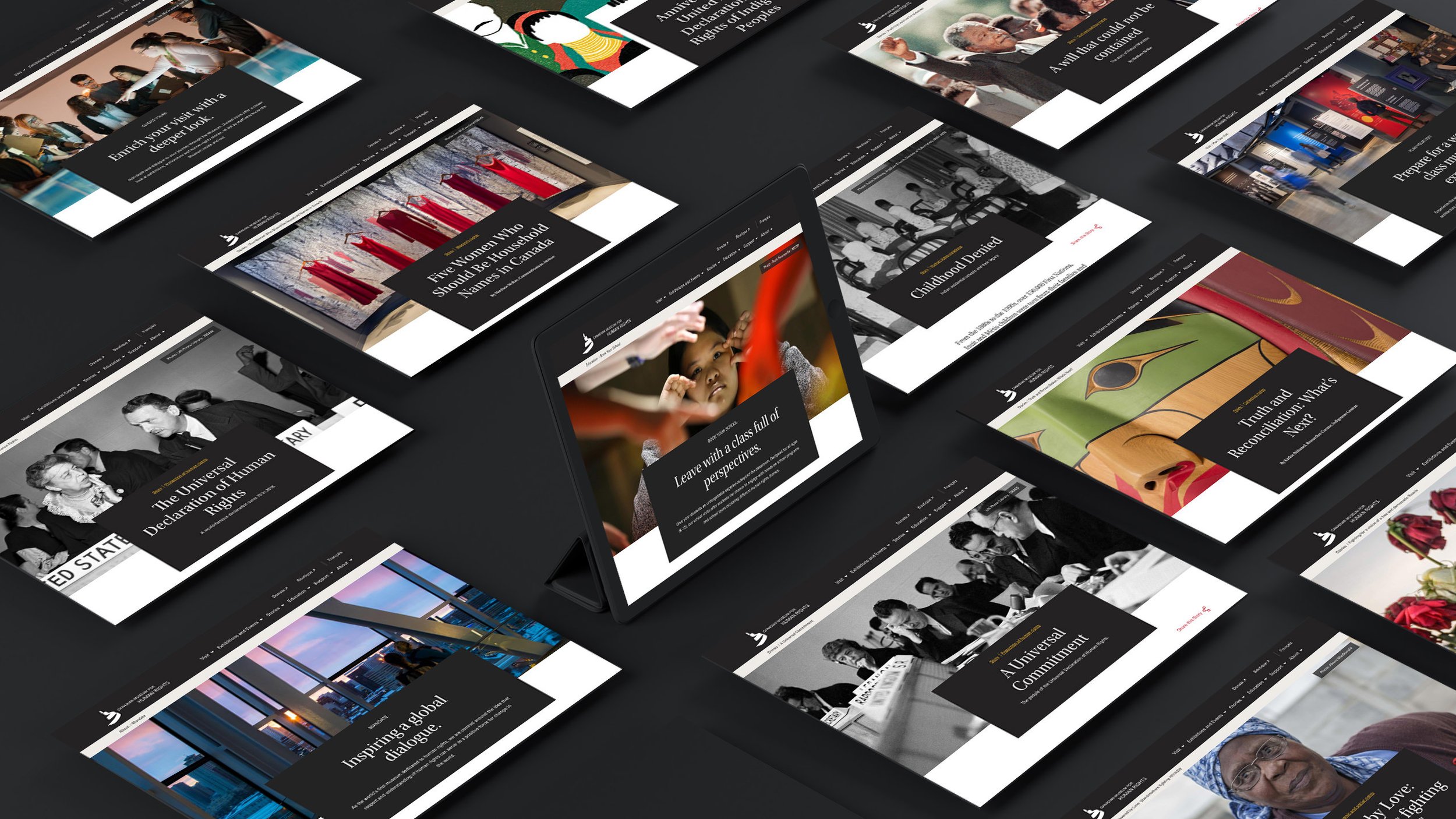
The Canadian Museum for Human Rights website

The virtual expression of an unparalleled visitor experience.

The only museum in the world solely dedicated to the reflection of human rights issues.

Role: UI/UX and production designer

Collage of various images, including a nighttime cityscape with a tall illuminated tower and a modern building, alongside black and white text and photographs.

Collage of photos from a human rights museum, featuring exhibit panels with texts about dignity, inclusion, and freedom of expression in various languages and formats.

A place for dialogue.

The goal was to create a virtual expression of the museum experience, so the website not only promotes the values of reflection and dialogue but also adheres to a range of visual cues from the journey through the physical space.

Based in Winnipeg, Canada the building itself is a visionary marvel steeped in symbolism. Its spiral design takes visitors on a journey upwards, leading from darkness to light. This progress serves as a metaphor for the struggle to fully realize human rights for all, immersed in remarkable stories.

A black and white photo of a historical meeting or conference with people seated around a table, and a quote overlaid that reads: 'There can be no peace unless human rights and freedoms are respected.' The quote is attributed to John Peters-Humphrey from the Universal Declaration of Human Rights, 1946 draft.
Photo of an upward view of a modern architectural interior with sunlight through a skylight, showing concrete and white walls.
Screenshots of three websites related to human rights: The first showing a museum with information on visiting hours and ticket purchasing, the second featuring the Universal Declaration of Human Rights with historical photos, and the third displaying an online store with ethical products and a museum collection.
A laptop, tablet, and smartphone all displaying the same webpage with a close-up image of a colorful mask, and the text "The Nuts and Bolts of Reconciliation" by Karine Duhamel, on a light beige background.
Three website screens for the Canadian Museum for Human Rights displaying exhibits, educational quotes, and membership options.
A black background with white text asking, "When you witness injustice, what do you do?" Below are four options with radio buttons: 1. Pull out my phone and record video, 2. Tell someone who might be able to help, 3. Step in and tell the violator to stop, 4. Don't get involved. There is also a button labeled "See What Others Said".

A place for reflection.

This museum is more than just artifacts, it’s a place built to engage people in the stories of others, encourage reflection on what they’ve witnessed, and spark dialogue.

Much focus was placed on providing space for moments of reflection and prompting further thought.

A quote by Armin T. Wegner over a dark background featuring a camera lens or a similar circular object.
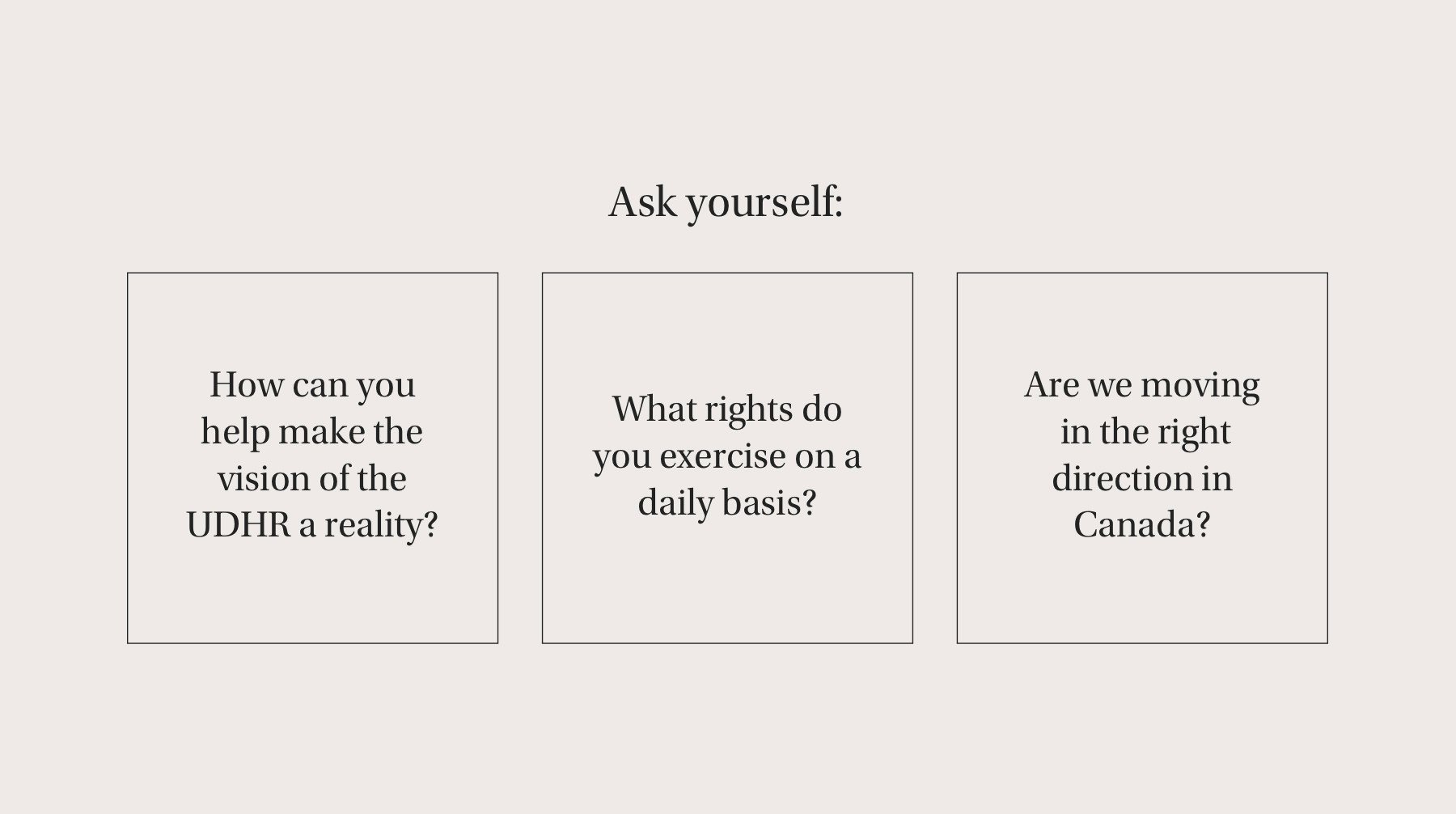
A digital worksheet titled 'Ask yourself:' with three questions in separate boxes: 'How can you help make the vision of the UDHR a reality?', 'What rights do you exercise on a daily basis?', and 'Are we moving in the right direction in Canada?'

A place to dive deeper.

The appearance of the site echoes much of the museum’s exhibit structure and displays content with a subtle sense of layers, reflecting the depth of information to explore and reinforcing a seamless experience between the real and the virtual.

A museum exhibit with panels of information, posters, and artifacts related to social and political issues. There are large images on digital screens at the top, and various signs, photos, and objects displayed on the walls and tables.
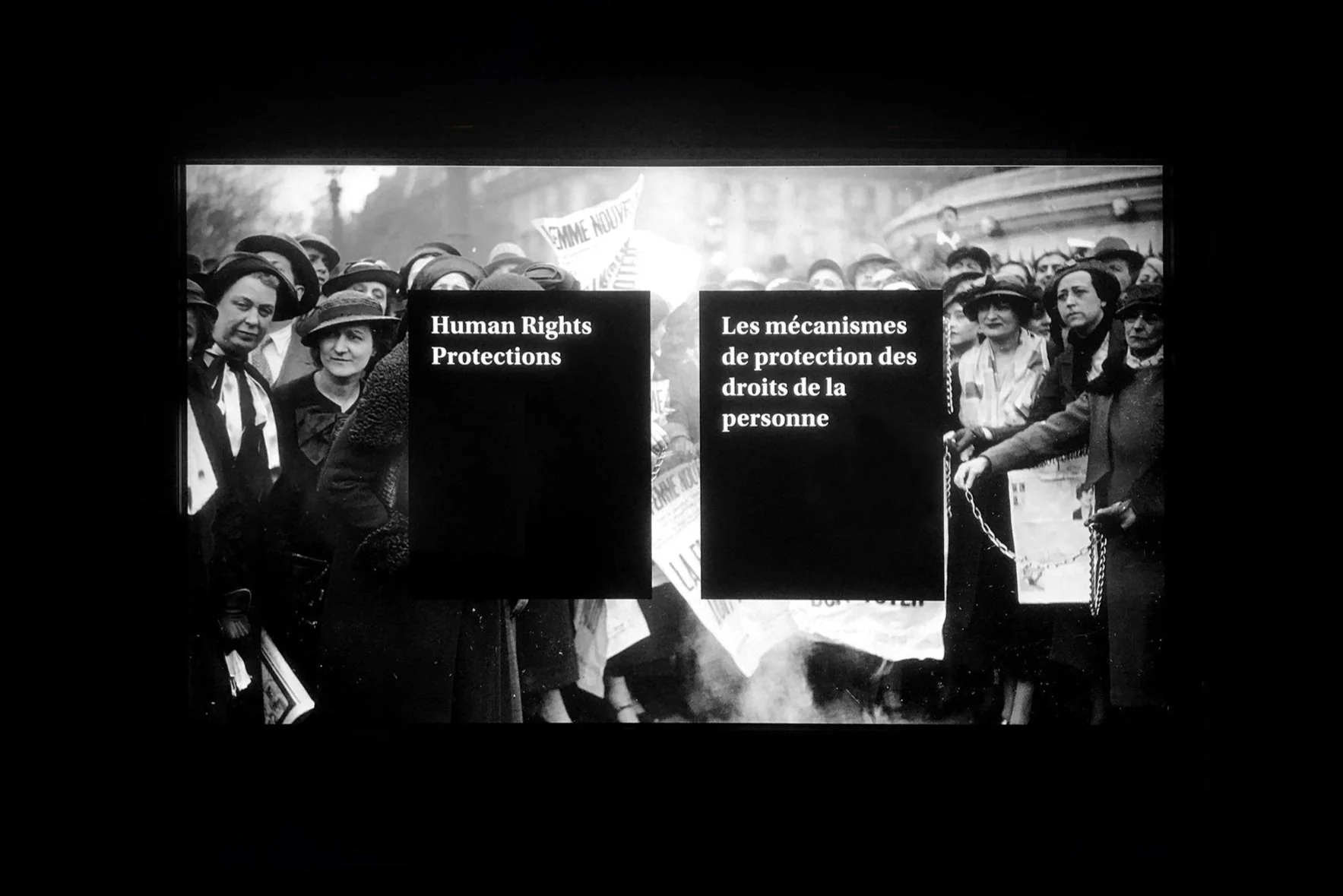
Black and white photo of a crowd of women holding protest signs that read 'Human Rights Protections' and its French translation, during a demonstration.
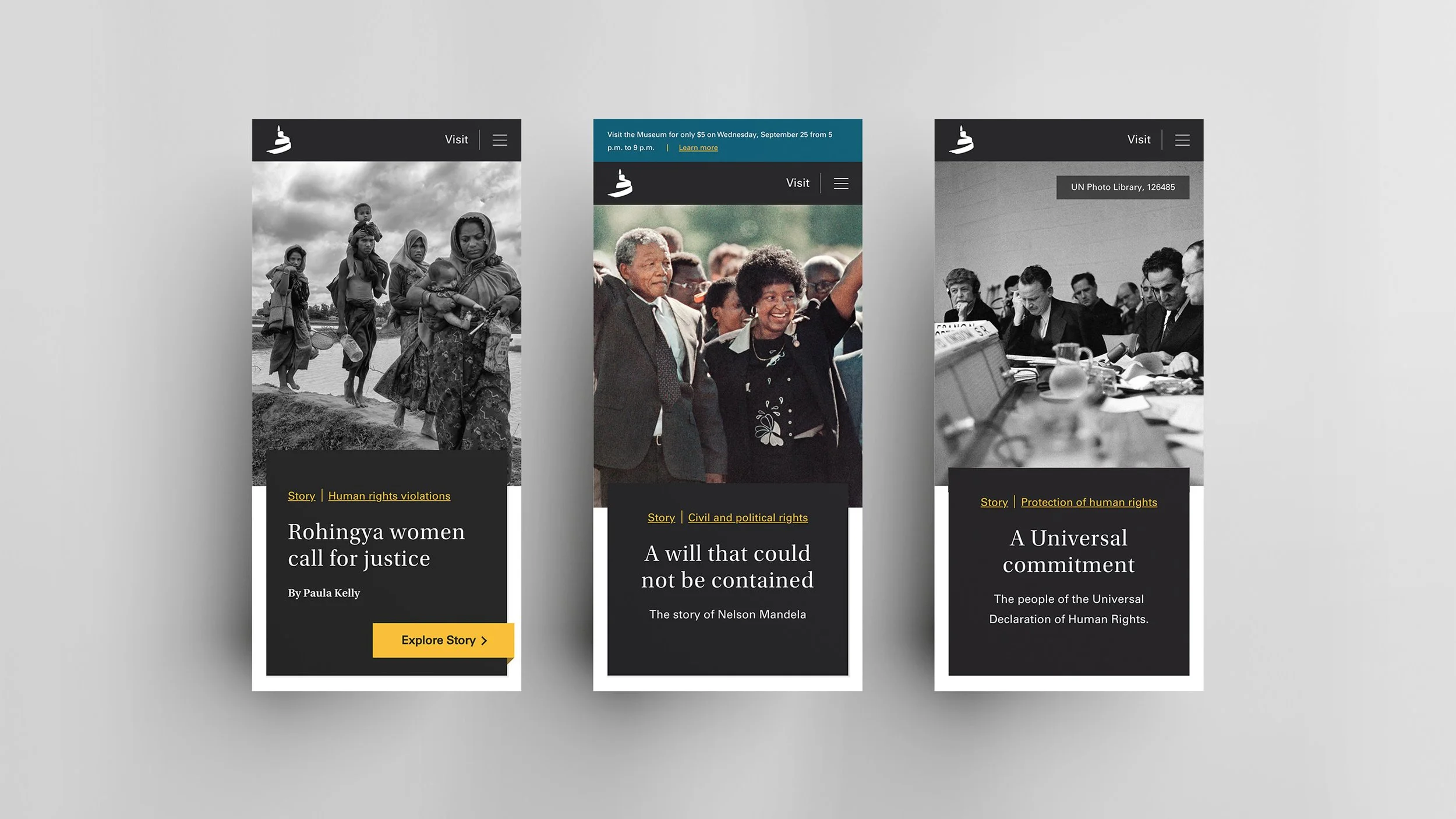
Three mobile website screenshots showcasing stories about human rights, each with a title, author, and a button to explore the story.
Two elongated screenshots of a website with historical and social justice content, featuring black and white images of people and various historical scenes, with some color images including a woman and a vintage car.

A place for exploration.

With an astonishing breadth of content in the museum, the website had to be robust and flexible enough to handle everything from online shopping and operational info to an ever-growing series of long-form articles and in-depth stories.

Our efforts to bring these stories to the world resulted in a 650% increase in user dwell time within the first year after launch.

A place for everyone.

The United Nations upholds internet access as a basic human right. Every decision made in the creation of the site was framed by the application of accessibility principles. From contrast considerations to content structure to semantic markup, everything was designed to meet a minimum of WCAG 2.0 AA compliance.

A black background with a centered white quote: 'The power of the Web is in its universality. Access by everyone regardless of disability is an essential aspect.' attributed to Tim Berners-Lee.

Role

Product Designer

Year: 2018
humanrights.ca

Credits

Creative Director:

Josh Fehr

UX:

Katherine Wearing

Contributing designers:

Tracey Lebedovitch
Alex Tench

Developers:

Gabrielle Carson
Djun Kim
Bryce Gilhome